One room: a single split
One indoor unit, one outdoor unit. The right answer for a main bedroom, a loft conversion, a lounge or a home office.
Most homes start here. Usually with the room that faces south and holds a grudge.
Bedroom like a greenhouse?
Home air conditioning, fitted properly by a refrigeration engineer. Free survey, one fixed price, and a tidy job you'll forget is there until July.
Air conditioning installation means fitting a slim unit inside, a compact unit outside, and a pair of pipes between them through one small hole in the wall.
Most single-room installs are done in a day.
We survey for free, give you one fixed price in writing, fit it, test it and show you how the remote works. Cool.
Britain gets about nine properly hot days a year.
They all arrive at once, usually when you have a loft bedroom and a meeting at nine.
You buy a fan. The fan moves the hot air from one side of the room to the other. You now have a breeze of soup.
This page explains what home air conditioning installation actually involves, what affects the price, and how we fit it without turning your house into a building site.
No jargon. Where we have to use a technical word, we'll say sorry first.
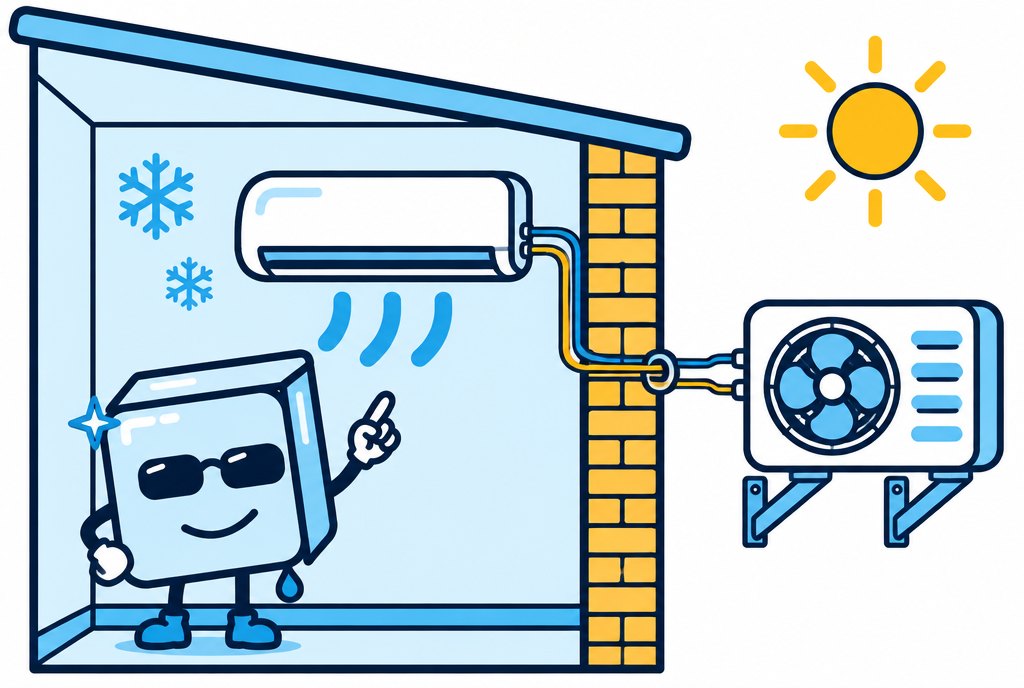
An air conditioner doesn't make cold. It moves heat.
It picks the warmth up from your room and dumps it outside, where it can annoy the pigeons instead.
The type we fit in most homes is called a split system, because it comes in two halves.
Everything runs through one neat hole about the width of a mug.
That's it. No ducts, no ceiling voids, no man in your loft for a fortnight.
It is, in effect, a fridge that has been turned inside out and pointed at your bedroom. Will has spent his whole career on fridges. Cool.
Almost every modern wall unit runs in reverse too.
In winter it collects heat from the outside air and brings it in, which makes it a very efficient heater for a home office, garden room or conservatory.
For every unit of electricity it uses, it typically moves three or more units of heat. A plug-in heater manages one.
So it earns its keep in January as well, which is more than can be said for the paddling pool.
There are two honest answers, and the survey decides which is yours.
One indoor unit, one outdoor unit. The right answer for a main bedroom, a loft conversion, a lounge or a home office.
Most homes start here. Usually with the room that faces south and holds a grudge.
One outdoor unit running two, three or more indoor units, each with its own remote and its own temperature.
One box outside instead of a row of them. The neighbours approve.
Air conditioners are sized in kilowatts (kW) of cooling.
As a rough guide, a typical bedroom wants around 2.5kW and a larger lounge somewhere between 3.5kW and 5kW.
But a rough guide is all that is. The real number depends on:
Too small and it runs flat out all day and never quite gets there.
Too big and it blasts the room cold, switches off, and leaves the air clammy.
Getting the size right is the dullest part of the job and the one that matters most. We measure. We don't guess. Cool.
From sweaty to sorted in five steps.
We measure the room, check the walls and find the best home for both units.
31°COne price in writing. Unit, fitting, pipework, the lot.
31°CDust sheets down, indoor unit up, one neat hole, outdoor unit on.
26°CPressure tested, leak checked, drained properly and run in both modes.
22°CWe show you the remote. Every button. Even the one nobody presses.
19°C
Will comes round, has a look and asks a few questions.
Which rooms get hot. When. Who sleeps where. Whether the dog has opinions.
Then he checks the things that decide how the job goes:
It takes about half an hour, and it's free whether you go ahead or not.
You are allowed to offer a cup of tea. This is not a condition of the survey. It is, however, noted.
After the survey you get one price, in writing.
It covers the unit, the fitting, the pipework, the brackets and the testing.
It doesn't grow legs on the day.
If the survey turns up something that changes the job, a long pipe run or an awkward wall, you hear about it in the quote and not halfway up a ladder.

Here's what actually happens in your house.
Most single-room installs are finished the same day.
A multi-room system takes longer, and we'll tell you how long before we start.
We hoover up. Will's mum raised him properly. Cool.
This is where a proper installation and a rushed one part company.
Before the system is switched on, the pipework is:
Then we run it in cooling and in heating, check the temperatures, and pour water through the drain to make sure it leaves the building by the correct exit.
"Do you pressure test and vacuum the pipework?" If the answer is a blank look, keep looking.
We don't leave until you know how to work it.
Cooling, heating, the timer, the quiet mode for night, and how to rinse the filters.
You'll also get the paperwork for the unit and its guarantee.
Then we go, and the room drops to nineteen degrees, and somebody in your house says "why didn't we do this years ago."
Every time. Cool.

This is the question people worry about most, so here's the straight answer.
The outdoor unit is about the size of a large suitcase.
It likes a spot with clear air around it, out of the way, and as close to the indoor unit as the house allows.
Good homes for it:
Places we'll talk you out of: right under a bedroom window, boxed into a cupboard with no airflow, or hard against next door's patio.
Less than you'd think.
On a low setting, most modern indoor units are about as loud as a whisper.
The outdoor unit makes a steady low hum when it's working hard, which is why where it sits and how it's mounted matter.
Rubber feet, solid fixings and a sensible spot do most of the work.
It depends, which is the most annoying answer in the trades, so here's what it depends on.
This is exactly why we survey before we quote.
A price given over the phone, sight unseen, is a guess with a pound sign on it.
Ours is fixed, written down and free to ask for.
Less than most people expect, because the unit moves heat instead of making it.
A typical bedroom unit uses very roughly 0.7kW of electricity while it's working hard, and much less once the room is down to temperature.
To work out a night's worth for yourself:
0.7kW × 8 hours = 5.6 units of electricity
Multiply that by the unit price on your electricity bill and you have your worst-case figure.
For comparison, it is considerably cheaper than a hotel, which is where you were about to sleep.
Often not, but it isn't a flat no either.
In England, many home installations count as permitted development, which means no planning application.
That comes with conditions, though, including:
The rules are tighter for flats and in conservation areas, and they don't apply to listed buildings at all.
The full list is on the Planning Portal.
We'll flag anything that looks borderline at the survey, and your council's planning team has the final word.
We would rather have that conversation before the drill comes out. So would your neighbours.
The refrigerant inside an air conditioner is a controlled gas.
By law, a business that installs, repairs or maintains air conditioning for customers must be F-Gas certified by an approved body.
You can read the rule on GOV.UK.
It isn't red tape for the sake of it.
It means the person connecting your pipework has been trained and assessed to handle the gas safely and keep it in the system, where it belongs.
WW Cool's F-Gas certificate number is [number]. Ask any installer for theirs. A good one will tell you before you've finished the question.
Will has spent years keeping supermarket delivery vans cold in the middle of August.
Your spare bedroom doesn't frighten him. Cool.
The four classic bodges, and how a proper install avoids them.
? Water dripping down the wall
✓ The unit wasn't level, or the drain runs uphill. We level the plate and test the drain with real water before we leave. Gravity has never once let us down.
? It's on, but the room isn't cold
✓ Usually an undersized unit or a slow leak from a poor joint. We size from a survey and pressure test every joint. Guessing is for quiz night.
? A hum coming through the wall
✓ The outdoor unit was bolted straight to the brickwork. Ours sit on rubber feet in a sensible spot. Your wall is not a speaker.
? Pipes wandering all over the house
✓ Nobody planned the route. We agree it with you at the survey and box it in neat trunking. It should look like it was always there.
WW Cool is based between Spalding and Peterborough and covers both, plus the towns and villages in between.
That includes the Deepings, Crowland, Pinchbeck, Thorney, Eye and Holbeach.
If you're a bit further out, ask. The van has air conditioning. Obviously.
We fit air conditioning in:
Most single-room installs are done in a day. A multi-room system takes longer, and we'll give you a clear timescale with your quote.
If one or two rooms are unbearable every summer, yes. You get proper sleep in a heatwave and an efficient heater in winter from the same unit.
Yes, one hole about the width of a mug, for the pipes, cable and drain. It's sealed afterwards and covered by the indoor unit on one side and trunking on the other.
Bedrooms are the most popular room we fit. We place the unit so it doesn't blow straight at the bed, and most have a quiet night mode.
Almost all modern wall units do. In heating mode they typically deliver three or more units of heat for each unit of electricity.
Often not, because many home installs are permitted development, but there are conditions and the rules differ for flats, conservation areas and listed buildings. We check at the survey.
Not a split system. Connecting and charging the refrigerant pipework is a job for an F-Gas certified engineer.
Once a year keeps it efficient and quiet. Rinse the filters yourself every few weeks in summer. We'll show you how at handover.
Now go and open a window. It won't help, but you'll feel you tried.